
On Gretchen Sleicher & Friends’ “Songs for the Great Turning” web site:
Category Archives: Uncategorized
Songs on the Theme of Gratitude
From Gretchen Sleicher’s “Songs for The Great Turning” web site.
 Gratitude is the ground we start from and come back to. It is a touchstone that is always available to support us, even in grief. Joining our voices in praise and appreciation of life on Earth adds a unique human beauty that the world needs us to contribute.
S O N G S W I T H L Y R I C S A N D R E C O R D I N G S
The Simple Praise of Trees, by David Densmore and Gretchen Sleicher
The Beauty of the Dancer, by Sara Thompsen
Let Us See the Beauty, by Laurence Cole
Oh to be Alive!, by Gretchen Sleicher
Magnificence, by Peter Makena
Unknown Blessings, by Ben Bochner
Songs on the Theme of Honoring Our Pain for the World
From Gretchen Sleicher’s “Songs for The Great Turning” web site

To acknowledge in song our pain for the world — the suffering of myriad beings and the destruction of the natural world — engenders a shared experience that breaks us out of denial. It lets us know we are not alone or “crazy” in these feelings, which arise from our caring and connectedness. Allowing them to surface in song is collective healing.
S O N G S W I T H L Y R I C S A N D R E C O R D I N G S
For the Mothers, by Betsy Rose
Ashes and Smoke, by Linda Allen
River of Tears, by Shasta Martinuk
Sing for the Trees, by Jenni Roditi
May This Be An Opening, by Gretchen Sleicher
In These Arms, A Song for All Beings — Jennifer Berezan
The official, beautiful, Jennifer Berezan music video produced by renowned photographer Irene Young with co-producer, Laurelin Remington-Wolf. Featuring excerpts from the making of the hour long chant CD including gorgeous footage of musicians from around the world, the Buddhist nuns of South Korea, and Jennifer Berezan.
Musicians include Jennifer Berezan, Jack Kornfield, Chris Webster, don benedictson, Dechen Shak-Dagsay (Tibet), Rita Sahai (India), Katia Cardenal (Nicaragua), Kiva Simova, The Buddhist Nuns of Unmun-sa Monastery, South Korea, David Worm, Melanie DeMore, Raz Kennedy, Sarah Dugas (French Canada), Steve Dawson, Julie Wolf, Jami Sieber, Milind Date (India) and more. For more info, visit https://www.edgeofwonder.com.
Please share this wonderful blessing for the planet with your friends:
https://www.youtube.com/watch?v=DzPTHstpJ2I
Freedom from Fear — Article By Aung San Suu Kyi
 It is not power that corrupts but fear. Fear of losing power corrupts those who wield it and fear of the scourge of power corrupts those who are subject to it. Most Burmese are familiar with the four a-gati, the four kinds of corruption. Chanda-gati, corruption induced by desire, is deviation from the right path in pursuit of bribes or for the sake of those one loves. Dosa-gati is taking the wrong path to spite those against whom one bears ill will, and moga-gati is aberration due to ignorance. But perhaps the worst of the four is bhaya-gati, for not only does bhaya, fear, stifle and slowly destroy all sense of right and wrong, it so often lies at the root of the other three kinds of corruption. Just as chanda-gati, when not the result of sheer avarice, can be caused by fear of want or fear of losing the goodwill of those one loves, so fear of being surpassed, humiliated or injured in some way can provide the impetus for ill will. And it would be difficult to dispel ignorance unless there is freedom to pursue the truth unfettered by fear. With so close a relationship between fear and corruption it is little wonder that in any society where fear is rife corruption in all forms becomes deeply entrenched.
Public dissatisfaction with economic hardships has been seen as the chief cause of the movement for democracy in Burma, sparked off by the student demonstrations 1988. It is true that years of incoherent policies, inept official measures, burgeoning inflation and falling real income had turned the country into an economic shambles. But it was more than the difficulties of eking out a barely acceptable standard of living that had eroded the patience of a traditionally good-natured, quiescent people – it was also the humiliation of a way of life disfigured by corruption and fear. The students were protesting not just against the death of their comrades but against the denial of their right to life by a totalitarian regime which deprived the present of meaningfulness and held out no hope for the future. And because the students’ protests articulated the frustrations of the people at large, the demonstrations quickly grew into a nationwide movement. Some of its keenest supporters were businessmen who had developed the skills and the contacts necessary not only to survive but to prosper within the system. But their affluence offered them no genuine sense of security or fulfilment, and they could not but see that if they and their fellow citizens, regardless of economic status, were to achieve a worthwhile existence, an accountable administration was at least a necessary if not a sufficient condition. The people of Burma had wearied of a precarious state of passive apprehension where they were ‘as water in the cupped hands’ of the powers that be.
Emerald cool we may be
As water in cupped hands
But oh that we might be
As splinters of glass
In cupped hands.
Glass splinters, the smallest with its sharp, glinting power to defend itself against hands that try to crush, could be seen as a vivid symbol of the spark of courage that is an essential attribute of those who would free themselves from the grip of oppression. Bogyoke Aung San regarded himself as a revolutionary and searched tirelessly for answers to the problems that beset Burma during her times of trial. He exhorted the people to develop courage: ‘Don’t just depend on the courage and intrepidity of others. Each and every one of you must make sacrifices to become a hero possessed of courage and intrepidity. Then only shall we all be able to enjoy true freedom.’
The effort necessary to remain uncorrupted in an environment where fear is an integral part of everyday existence is not immediately apparent to those fortunate enough to live in states governed by the rule of law. Just laws do not merely prevent corruption by meting out impartial punishment to offenders. They also help to create a society in which people can fulfil the basic requirements necessary for the preservation of human dignity without recourse to corrupt practices. Where there are no such laws, the burden of upholding the principles of justice and common decency falls on the ordinary people. It is the cumulative effect on their sustained effort and steady endurance which will change a nation where reason and conscience are warped by fear into one where legal rules exist to promote man’s desire for harmony and justice while restraining the less desirable destructive traits in his nature.
In an age when immense technological advances have created lethal weapons which could be, and are, used by the powerful and the unprincipled to dominate the weak and the helpless, there is a compelling need for a closer relationship between politics and ethics at both the national and international levels. The Universal Declaration of Human Rights of the United Nations proclaims that ‘every individual and every organ of society’ should strive to promote the basic rights and freedoms to which all human beings regardless of race, nationality or religion are entitled. But as long as there are governments whose authority is founded on coercion rather than on the mandate of the people, and interest groups which place short-term profits above long-term peace and prosperity, concerted international action to protect and promote human rights will remain at best a partially realized struggle.. There will continue to be arenas of struggle where victims of oppression have to draw on their own inner resources to defend their inalienable rights as members of the human family.
The quintessential revolution is that of the spirit, born of an intellectual conviction of the need for change in those mental attitudes and values which shape the course of a nation’s development. A revolution which aims merely at changing official policies and institutions with a view to an improvement in material conditions has little chance of genuine success. Without a revolution of the spirit, the forces which produced the iniquities of the old order would continue to be operative, posing a constant threat to the process of reform and regeneration. It is not enough merely to call for freedom, democracy and human rights. There has to be a united determination to persevere in the struggle, to make sacrifices in the name of enduring truths, to resist the corrupting influences of desire, ill will, ignorance and fear.
Saints, it has been said, are the sinners who go on trying. So free men are the oppressed who go on trying and who in the process make themselves fit to bear the responsibilities and to uphold the disciplines which will maintain a free society. Among the basic freedoms to which men aspire that their lives might be full and un-cramped, freedom from fear stands out as both a means and an end. A people who would build a nation in which strong, democratic institutions are firmly established as a guarantee against state-induced power must first learn to liberate their own minds from apathy and fear.
Always one to practise what he preached, Aung San himself constantly demonstrated courage – not just the physical sort but the kind that enabled him to speak the truth, to stand by his word, to accept criticism, to admit his faults, to correct his mistakes, to respect the opposition, to parley with the enemy and to let people be the judge of his worthiness as a leader. It is for such moral courage that he will always be loved and respected in Burma – not merely as a warrior hero but as the inspiration and conscience of the nation. The words used by Jawaharlal Nehru to describe Mahatma Gandhi could well be applied to Aung San:
‘The essence of his teaching was fearlessness and truth,
and action allied to these, always keeping the welfare of
the masses in view.’
Gandhi, that great apostle of non-violence, and Aung San, the founder of a national army, were very different personalities, but as there is an inevitable sameness about the challenges of authoritarian rule anywhere at any time, so there is a similarity in the intrinsic qualities of those who rise up to meet the challenge. Nehru, who considered the instillation of courage in the people of India one of Gandhi’s greatest achievements, was a political modernist, but as he assessed the needs for a twentieth-century movement for independence, he found himself looking back to the philosophy of ancient India: ‘The greatest gift for an individual or a nation … was abhaya, fearlessness, not merely bodily courage but absence of fear from the mind.’
Fearlessness may be a gift but perhaps more precious is the courage acquired through endeavour, courage that comes from cultivating the habit of refusing to let fear dictate one’s actions, courage that could be described as ‘grace under pressure’ – grace which is renewed repeatedly in the face of harsh, unremitting pressure.
Within a system which denies the existence of basic human rights, fear tends to be the order of the day. Fear of imprisonment, fear of torture, fear of death, fear of losing friends, family, property or means of livelihood, fear of poverty, fear of isolation, fear of failure. A most insidious form of fear is that which masquerades as common sense or even wisdom, condemning as foolish, reckless, insignificant or futile the small, daily acts of courage which help to preserve man’s self-respect and inherent human dignity. It is not easy for a people conditioned by fear under the iron rule of the principle that might is right to free themselves from the enervating miasma of fear. Yet even under the most crushing state machinery courage rises up again and again, for fear is not the natural state of civilized man.
The wellspring of courage and endurance in the face of unbridled power is generally a firm belief in the sanctity of ethical principles combined with a historical sense that despite all setbacks the condition of man is set on an ultimate course for both spiritual and material advancement. It is his capacity for self-improvement and self-redemption which most distinguishes man from the mere brute. At the root of human responsibility is the concept of perfection, the urge to achieve it, the intelligence to find a path towards it, and the will to follow that path if not to the end at least the distance needed to rise above individual limitations and environmental impediments.
It is man’s vision of a world fit for rational, civilized humanity which leads him to dare and to suffer to build societies free from want and fear. Concepts such as truth, justice and compassion cannot be dismissed as trite when these are often the only bulwarks which stand against ruthless power.
Aung San Suu Kyi (1990)
VIDEO: Joanna Macy on Honoring Our Pain for the World
November 2010 — St. Mark’s Catherdral, Seattle (YouTube Video)
ARTICLE: Fred Luskin on Forgiveness
Introduction (excerpt from The Stanford Daily, February 4, 2002 )
New studies look at forgiveness – by Gohar Galyan
To earn his doctorate in counseling and health psychology from Stanford in 1997, Fred Luskin had to write a dissertation. At the time, Luskin was furious with a friend. To complete his graduation requirement and to cope with the pain, Luskin researched and wrote about forgiveness.
“I couldn’t do it. I couldn’t forgive,” he said. “I was badly hurt by a friend of mine and it threw my world upside down.”
Luskin, now a research associate with the Stanford Center for Research in Disease Prevention, focused on Stanford students’ experiences when he initially began studying forgiveness. In 1999, after earning his doctorate, Luskin launched the original Stanford Forgiveness Project, which studied Bay Area residents. According to Luskin, the study involved 260 participants, including 100 men.
“The results were very positive,” Luskin said. “People showed less stress, less anger, more optimism and more forgiveness.”
Research is conducted in a workshop format and typically lasts from five to six weeks, he said. In his research, he teaches forgiveness as a skill.
“It is not therapy. It is teaching people how to learn this kind of skill,” he said. “We can teach people to forgive and that will improve their well-being.”
The Stanford Forgiveness Project has evolved and now exists as an umbrella organization for numerous Stanford research projects that address forgiveness.
Over the years, researchers with the Stanford Forgiveness Project have worked with families from Ireland who have lost loved ones due to civil strife. The Stanford- Northern Ireland HOPE Project has conducted research on three different occasions with Irish families.
Four Steps Toward Forgiveness
from Healing Currents Magazine — Sept/Oct 1996
The process of forgiveness can be a liberating experience. One that if practiced proactively can lead to a wonderful experience of life. Interestingly, forgiveness can only occur because we have been given the gift of the ability to make choices. We have the choice to forgive or not to forgive and no one can force us to do either. Conversely, if we want to forgive someone no one can stop us no matter how poorly they may act. This ability to forgive is a manifestation of the personal control we have over our lives. It is nice to reflect upon and feel the respect that we have been given to be able to make such profound choices.
Compellingly, the option to forgive also implies that we had discretion as to whether or not we took offense in the first place. While forgiving may be a difficult enough choice for many of us, imagine how our lives would be if we rarely or never used our power of choice to take offense. Since we have choice, wouldnít it make sense to limit the amount of times we are hurt or offended so that the need to forgive rarely if ever arises? The ability to live life without taking offense, without giving blame, and by offering forgiveness are choices that offer a life of great peace.
The ability to offer proactive forgiveness proceeds along four steps. At step one you are filled with self justified anger. At some point in your life you have been hurt and you are mad at the person you feel wronged you. You blame the person committing the wrong for how you are feeling. It is their action and not your choice of response that you feel is at the cause of your anger. You have forgotten that you have a choice as to how you will react, or are so angry that you are convinced that it would not be right to forgive the offense. At this stage there is usually both active and submerged anger.
The second step towards forgiveness emerges when after feeling angry with someone for a while you realize that the anger does not feel good to you. It may be hurting your emotional balance or your physical health. Or you wish to repair the damage to the relationship. So you take steps to forgive. You may begin to see the problem from the other personís point of view or you may simply decide to let the problem go. In either case after an extended period of time you are no longer angry and you have forgiven the person with whom you were angry. This process can be applied to anger at oneself, another person or to life in general.
The third stage of forgiveness comes after you have seen the beneficial results of forgiveness and you choose to let go of your anger fairly quickly. In this stage the choice is to feel the hurt for a short period of time, and then work to either repair the relationship or let go of seeing the situation as a problem. In either case you decide to forgive because you have had some practice with it and see the benefit in your life. This could emerge in as simple a situation as being cut off by another car on the expressway or in a complex situation like an affair in a marriage. At this stage you are aware that the length of time you experience the situation as a grievance is primarily up to you.
The fourth stage of forgiveness involves the proactive choice to rarely if ever get angry. This means often to forgive in advance of a specific trigger. This stage often emerges at the same time as some or all of the following thoughts:
I don’t want to waste my precious life in the discomfort caused by anger so I will choose to feel differently. I am able to forgive myself, forgive others, forgive life, and forgive God.
I know how it hurts when people donít forgive me. I do not want to hurt other people by my anger so I will let it go.
Life is filled with incredible beauty and I am missing some if I am experiencing unresolved anger. I forgive myself for getting sidetracked.
People do the best they can and if they err I can best help them by offering understanding. The first step in this process is to forgive the specific offense.
Everyone, including myself operates primarily out of self-interest. I must expect that some times I, in my self-interest, will be annoyed by some one else’s expression of their self-interest. If I can understand that this is an ordinary part of life, what is there to be upset about? If I understand that self interest is the way that I behave, how can I but offer forgiveness to everyone, including myself for behaving that way?
These four stages of forgiveness will not be followed in the same way by all people and in all relationships. There are some people for whom we feel such love that we are almost always at stage four: open hearted and ready to forgive. There are other people for whom we feel so egregiously hurt and our well of good will for them is so dry that we can spend years at stage one. What is critical to remember is the power of personal choice and the importance of exercising that choice to forgive so that we can bring peace and healing into our relationships and ourselves.
Nine Steps to Forgiveness
from “Forgive for Good” (Harper Collins, 2002)
by Frederic Luskin, Ph.D.
1. Know exactly how you feel about what happened and be able to articulate what about the situation is not OK. Then, tell a couple of trusted people about your experience.
2. Make a commitment to yourself to do what you have to do to feel better. Forgiveness is for you and not for anyone else.
3. Forgiveness does not necessarily mean reconciliation with the person that upset you, or condoning of their action. What you are after is to find peace. Forgiveness can be defined as the “peace and understanding that come from blaming that which has hurt you less, taking the life experience less personally, and changing your grievance story.”
4. Get the right perspective on what is happening. Recognize that your primary distress is coming from the hurt feelings, thoughts and physical upset you are suffering now, not what offended you or hurt you two minutes or ten years ago.
5. At the moment you feel upset practice a simple stress management technique to soothe your body’s flight or fight response.
6. Give up expecting things from other people, or your life, that they do not choose to give you. Recognize the “unenforceable rules” you have for your health or how you or other people must behave. Remind yourself that you can hope for health, love, friendship and prosperity and work hard to get them.
7. Put your energy into looking for another way to get your positive goals met than through the experience that has hurt you. Instead of mentally replaying your hurt seek out new ways to get what you want.
8. Remember that a life well lived is your best revenge. Instead of focusing on your wounded feelings, and thereby giving the person who caused you pain power over you, learn to look for the love, beauty and kindness around you.
9. Amend your grievance story to remind you of the heroic choice to forgive.
Please note: Dr. Luskin expands on these suggestions in his new book, Forgive for Good , which you can order through the New Conversations Bookstore and Reading List . For more information about Dr. Luskin’s work please visit www.learningtoforgive.com
 Fred Luskin, PhD, is a Professor at the Institute of Transpersonal Psychology in Palo Alto, CA, where he teaches tests and measurement and forgiveness classes. He is the Director of the Stanford Forgiveness Projects – a series of research projects affirming his forgiveness training methodology. He has taught and lectured on forgiveness worldwide and has been featured for his forgiveness work in many major media outlets. Dr. Luskin is a licensed Marriage and Family Therapist and a Nationally Certified School Psychologist.
VIDEO: Joanna Macy on Gratitude as a Revolutionary Act
[field HTML-video-j-macy-on-gratitude]
From the Work That Reconnects Training DVD with Joanna Macy.
Recorded at a 2005 Intensive and 2006 Palo Alto Workshop.
VIDEO: Jeremy Rifkin on the Empathic Civilization
[break]
 [break]
RSA ANIMATE: The Empathic Civilisation
BOOK: Gratefulness, the Heart of Prayer
Recommended by Dennis Rivers
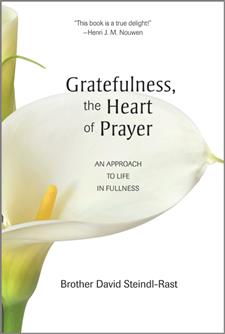
Gratefulness, The Heart of Prayer
An Approach to Life in Fullness
Brother David Steindl-Rast
Brother David Steindl-Rast explores the many meanings and benefits of the spiritual practice of gratitude. Here is an excerpt that explains the link between joy and gratefulness.
“Ordinary happiness depends on happenstance. Joy is that extraordinary happiness that is independent of what happens to us. Good luck can make us happy, but it cannot give us lasting joy. The root of joy is gratefulness. We tend to misunderstand the link between joy and gratefulness. We notice that joyful people are grateful and suppose that they are grateful for their joy. But the reverse is true: their joy springs from gratefulness. If one has all the good luck in the world, but takes it for granted, it will not give one joy. Yet even bad luck will give joy to those who manage to be grateful for it. We hold the key to lasting happiness in our own hands. For it is not joy that makes us grateful; it is gratitude that makes us joyful.”
Click here to buy this book from online bookstores around the world.