Category Archives: Uncategorized

Gratitude Quotes from Meister Eckhart & C.K. Chesterton


If the only prayer you said in your whole life was ‘Thank you,’  
that would be enough. ~ Meister Eckhart (1260-1328) 

I would maintain that thanks are the highest form of thought,   
and that gratitude is happiness doubled by wonder.   
~ Gilbert Keith Chesterton 


M. K. Gandhi on Living the Answers


[break]
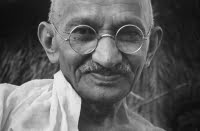
gandhi1-200pxw

“You must be the change you want to see in the world.”

REFERENCE: Interview with Arun Gandhi, grandson of M.K. Gandhi
https://www.pbs.org/kcet/globaltribe/voices/voi_gandhi.html

AMY ELDON: One of Gandhiji’s most famous sayings is, “We must be the change we wish to see.” In what context did he say that and what does it really mean?

ARUN GANDHI: Well he said this when he was speaking after prayer service and he mentioned this because people kept saying to him that the world has to change for us to change. He said, “No, the world will not change if we don’t change.” So we have to make the beginning ourselves. It has always been our human nature to blame someone else for everything that is happening. It’s never us. We are never at fault. And he tried to make us realize that we are just as much in the fault as anybody else. Unless we change ourselves and help people around us change, nobody will change because then everybody will be waiting for the other person to change.


“For me whatever is in the atoms and molecules is in the universe. I believe in the saying that what is in the microcosm of one’s self is reflected in the macrocosm.”  

REFERENCE: 4 April 1947,  The Collected Works of Mahatma Gandhi  (CWMG) , vol. 87, p. 207.


“My life is my message.” 

REFERENCE:  Douglas Allen (2008).  The Philosophy of Mahatma Gandhi for the Twenty-First Century . Lexington Books. p. 34.


Ben Bochner – Give Thanks for Unknown Blessings

[embedit snippet=”ben-bochner-song-unknown-blessings”]

Performed February 10, 2012 at Tsunami Books, Eugene OR. Accompanied by Rob Tobias on harmonica and Brook Adams on guitar. First public performance of this song reflecting on the Occupy movement, from the final set of a “Songwriter Showcase” organized by Rob Tobias. Bochner is a singer-songwriter based in Eugene. Rob Tobias performs solo and with the Northwest Express; Brook Adams is bandleader for the Swingin’ Marmalukeys. Video by Randy Prince. More Ben Bochner songs on MySpace .

[break]

Gratitude: A quote from Jack Kornfield and Joseph Goldstein


A number of years ago the Menninger Foundation sponsored a conference at which Mad Bear, an Iroquois medicine man, spoke. After several days of meetings at which scientific papers were presented, it was his turn. He said, ‘For my presentation I’d like us to begin by going outside.’ Everyone followed him outside to an open field, and he asked us all to stand silently in a circle. We stood for a while in silence under a wide open sky, surrounded by fields of grain stretching to the horizon. Mad Bear then began to speak, offering a prayer of gratitude. He thanked the earthworms for aerating the soil so that plants can grow. He thanked the grasses that cover the earth for keeping the dust from blowing, for cushioning our steps, and for showing our eyes the greenness and beauty of their life. He thanked the wind for bringing rain, for cleaning the air, for giving us the life-breath that connects us with all beings. He spoke in this way for nearly an hour, and as we listened our mindfulness grew with each prayer. We felt the wind on our faces and the earth beneath our feet, and we saw the grass and clouds, all with a sense of connectedness, gratitude, and love.”

From Seeking the Heart of Wisdom: The Path of Insight Meditation by Joseph Goldstein and Jack Kornfield


Seven Quotes about Gratitude


  From Melanie Greenberg’s article on PsychologyToday.com .


  1.  “Let us be grateful to people who make us happy; they are the charming gardeners who make our souls blossom.”  — Marcel Proust


  2. “We can only be said to be alive in those moments when our hearts are conscious of our treasures.”   — Thornton Wilder


  3. “As we express our gratitude, we must never forget that the highest appreciation is not to utter words, but to live by them.”  — John F. Kennedy 


  4. “At times our own light goes out and is rekindled by a spark from another person. Each of us has cause to think with deep gratitude of those who have lighted the flame within us.”  — Albert Schweitzer 


  5. “The deepest craving of human  nature  is the need to be appreciated.”   — William James


  6. “Be thankful for what you have; you’ll end up having more. If you concentrate on what you don’t have, you will never, ever have enough.”  — Oprah Winfrey


  7. “He is a  wise  man who does not grieve for the things which he has not, but rejoices for those which he has.”  — Epictetus 


Earth, Heart, and Spirit: A Declaration of Connectedness


By David Richo, PhD
Psychotherapist, author, pastoral counselor
www.davericho.com


How do I contribute to a planetary shift from the three poisons of our human environment: greed, hate, and ignorance, to the three drivers of our evolution: justice, peace, and love?
 
A zeal for the transformation of society and the world is how we personally evolve in love. This means that when we fight against the domination systems of aggression and inequality, we are showing and growing in love for the world.
 
Once earth is no longer the ground we walk on but our living mother, we are called to protect and nurture her as she does us. Only when we love earth and its people do we fully love. Then we pray with mother earth not just for our personal satisfaction or gain. When we love we co-create and co-heal the world so it can evolve. Connection is implicit in co-creation since we all join to help the world evolve by conscious intention and specific actions.
 
To love the world is to become planetary citizens. Our individual consciousness and our earth consciousness become one and the same, no division, no dualism, no ranking. Once love and connection are accepted as our authentic identity, war and hate have no place in our hearts or our world. Care for the ecology and cooperation with others become our intensely held commitments.
 
We work in whatever way we can to stop any further denuding of the earth of her natural resources and we do what it takes to renew the powers of the earth. That is love for the world shown in action. Love is then our new primary principle and value.
 
We can expand our earth-and-its-people love by consciously checking into our attitudes toward and contributions to the following social sins:
  • The unjust distribution of goods that is based on the vast differential between rich and poor
  • Destruction of the environment and its ecology
  • Violence, war, and nuclear arms
  • Oppression and prejudice based on race, sexual orientation, and religion
  • The political and religious oppression of women in patriarchal societies
 
A common element in all five of these forms of social injustice is domination, what happens when egalitarian relations towards others are denied. Love can’t survive with domination, patriarchy, control, rapacity, violence, and repression.
 
I close my reflections with two quotes that help me expand my horizons of possibility:
 
Politics and the life of the spirit are inseparable. –Mahatma Gandhi
 

Politics is the supreme expression of charity. –Pope Pius XI


A New Declaration — Derrick Jensen


February 1, 2012  —  From: https://occupiedmedia.us/2012/02/a-new-declaration/


We hold these truths to be self-evident:
 
That the real, physical world is the source of our own lives, and the lives of others. A weakened planet is less capable of supporting life, human or otherwise.
 
Thus the health of the real world is primary, more important than any social or economic system, because all social or economic systems are dependent upon a living planet.
 
It is self-evident that to value a social system that harms the planet’s capacity to support life over life itself is to be out of touch with physical reality.
 
That any way of life based on the use of nonrenewable resources is by definition not sustainable.
 
That any way of life based on the hyper-exploitation of renewable resources is by definition not sustainable: if, for example, fewer salmon return every year, eventually there will be none. This means that for a way of life to be sustainable, it must not harm native communities: native prairies, native forests, native fisheries, and so on.
 
That the real world is interdependent, such that harm done to rivers harms those humans and nonhumans whose lives depend on these rivers, harms forests and prairies and wetlands surrounding these rivers, harms the oceans into which these rivers flow. Harm done to mountains harms the rivers flowing through them. Harm done to oceans harms everyone directly or indirectly connected to them.
 
That you cannot argue with physics. If you burn carbon-based fuels, this carbon will go into the air, and have effects in the real world.
 
That creating and releasing poisons into the world will poison humans and nonhumans.
 
That no one, no matter how rich or powerful, should be allowed to create poisons for which there is no antidote.
 
That no one, no matter how rich or powerful, should be allowed to create messes that cannot be cleaned up.
 
That no one, no matter how rich or powerful, should be allowed to destroy places humans or nonhumans need to survive.
 
That no one, no matter how rich or powerful, should be allowed to drive human cultures or nonhuman species extinct.
 
That reality trumps all belief systems: what you believe is not nearly so important as what is real.
 
That on a finite planet you cannot have an economy based on or requiring growth. At least you cannot have one and expect to either have a planet or a future.
 
That the current way of life is not sustainable, and will collapse. The only real questions are what will be left of the world after that collapse, and how bad things will be for the humans and nonhumans who come after. We hold it as self-evident that we should do all that we can to make sure that as much of the real, physical world remains intact until the collapse of the current system, and that humans and nonhumans should be as prepared as possible for this collapse.
 
That the health of local economies are more important than the health of a global economy.
 
That a global economy should not be allowed to harm local economies or land bases.
 
That corporations are not living beings. They are certainly not human beings.
 
That corporations do not in any real sense exist. They are legal fictions. Limited liability corporations are institutions created explicitly to separate humans from the effects of their actions—making them, by definition, inhuman and inhumane. To the degree that we desire to live in a human and humane world—and, really, to the degree that we wish to survive—limited liability corporations need to be eliminated.
 
That the health of human and nonhuman communities is more important than the profits of corporations.
 
We hold it as self-evident, as the Declaration of Independence states, “That whenever any Form of Government becomes destructive of these ends [Life, Liberty, and the Pursuit of Happiness], it is the Right of the People to alter or abolish it. . . .” Further, we hold it as self-evident that it would be more precise to say that it is not the Right of the People, nor even their responsibility, but instead something more like breathing—something that if we fail to do we die.
 
If we as a People fail to rid our communities of destructive institutions, those institutions will destroy our communities. And if we in our communities cannot provide meaningful and nondestructive ways for people to gain food, clothing, and shelter then we must recognize it’s not just specific destructive institutions but the entire economic system that is pushing the natural world past breaking points. Capitalism is killing the planet. Industrial civilization is killing the planet.
 
Once we’ve recognized the destructiveness of capitalism and industrial civilization—both of which are based on systematically converting a living planet into dead commodities—we’ve no choice, unless we wish to sign our own and our children’s death warrants, but to fight for all we’re worth and in every way we can to overturn it.

This item first appeared at https://occupiedmedia.us/2012/02/a-new-declaration/ on the Occupied Media web site, and is licensed under a Creative Commons Attribution-NonCommercial-ShareAlike 3.0 Unported License. Based on a work at occupiedmedia.us.  Permissions beyond the scope of this license may be available at https://occupiedmedia.us.


ABOUT DERRICK JENSEN: (from Wikipedia) Derrick Jensen is an American author and environmental activist living in Crescent City, California. Jensen has published several books questioning and critiquing modern civilization and its values, including A Language Older Than Words, The Culture of Make Believe, and Endgame. He holds a B.S. in Mineral Engineering Physics from the Colorado School of Mines and an M.F.A. in Creative Writing from Eastern Washington University. He has also taught creative writing at Pelican Bay State Prison and Eastern Washington University.



Declaration of the Four Sacred Things — By Starhawk


The earth is a living, conscious being. In company with cultures of many different times and places, we name these things as sacred:
 
air, fire, water, and earth.
 
Whether we see them as the breath, energy, blood, and body of the Mother, or as the blessed gifts of a Creator, or as symbols of the interconnected systems that sustain life, we know that nothing can live without them.
 
To call these things sacred is to say that they have a value beyond their usefulness for human ends, that they themselves become the standards by which our acts, our economics, our laws, and our purposes must be judged. No one has the right to appropriate them or profit from them at the expense of others. Any government that fails to protect them forfeits its legitimacy.
 
All people, all living things, are part of the earth life, and so are sacred. No one of us stands higher or lower than any other. Only justice can assure balance: only ecological balance can sustain freedom. Only in freedom can that fifth sacred thing we call spirit flourish in its full diversity.
 
To honor the sacred is to create conditions in which nourishment, sustenance, habitat, knowledge, freedom, and beauty can thrive. To honor the sacred is to make love possible.
 
To this we dedicate our curiosity, our will, our courage, our silences, and our voices. To this we dedicate our lives.
 
–from Starhawk, The Fifth Sacred Thing